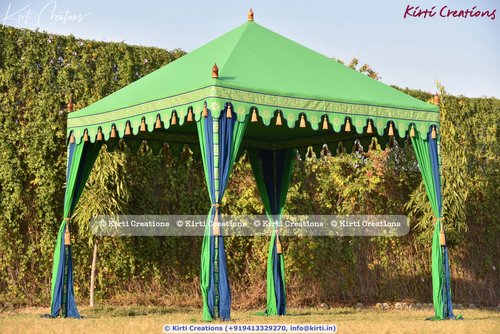
Every commission begins the same way: with an idea that does not yet exist anywhere.
A pavilion for a granddaughter’s wedding, in the exact rose-and-gold of the family crest. A signature suite for a heritage property, grand enough to be photographed from the ramparts. The idea arrives as a feeling, and somebody has to turn it into forty feet of standing architecture in fabric.
That somebody is a Mughal tent manufacturer. Here is how the journey actually unfolds, from the first conversation to the final peg.
A Tradition of Travelling Palaces
The royal Mughal tent was never merely a shelter. The imperial encampments of old were travelling palaces, where Persian geometry married Indian handwork, with arched profiles, scalloped valances, and interiors printed as richly as any durbar hall.
Which is why customisation is not an added service in this craft. It is the entire point of the form. No emperor ever ordered a standard model, and no discerning family should either.
From Concept to Canvas: The Custom Journey, Stage by Stage
Each stage below is a checkpoint for the workshop, and for you. A manufacturer who cannot walk you through all five is not the one to trust with your name.
1. The Design Consultation
Begin with the story, not the dimensions. Bring photographs of the site, references you admire, the guest count, and above all the occasion, because a Mughal tent for weddings is planned around ceremony sightlines and dining flow, while an estate tent is planned around permanence and view.
Share the awkward details too: sloping lawns, old trees you refuse to cut, a monsoon deadline. Good workshops design around constraints; great ones turn them into features.
2. Choosing Fabric, Colour, and Motif
Compare canvas weights in person. A heavy marquee-grade canvas drapes and endures quite differently from anything lighter. If the tent will live outdoors through the seasons, specify treated, rot-proof, weather-resistant canvas for the exterior from the very first sample.
Then comes the pleasure: choosing the hand-block printed lining, the motifs, the family colours running through valance and pole covers. Ask to see print blocks and dye samples, not just catalogues.
What you gain: a custom Mughal tent that is recognisably, unmistakably yours.
3. Engineering Beneath the Finery
Now the unglamorous stage that quietly decides everything. Ask how the frame is engineered, including the spans, the bracing, and the wind it has been designed to shrug off. A serious Mughal tent manufacturer engineers first and decorates second, because embroidery cannot hold up a roof.
If your site faces high winds or open ground, say so now; frames are designed to conditions, not adjusted to them afterwards.
What you gain: grandeur that stands its ground.
4. The Artisans’ Floor
This is where weeks are spent, and should be. Printers pull each panel of lining by hand, block after block. Embroiderers work the valves. Tailors join hundreds of metres of fabric so that seams disappear into pattern.
Ask for a realistic timeline and be suspicious of a short one. Handwork at this level takes the time it takes. A luxury Mughal tent hurried through the floor will show its hurry for years.
What you gain: detailing that rewards a second look, and a tenth.
5. Trial Assembly and Installation
Insist on a full trial pitch at the workshop before anything is dispatched. Every pole, every panel, and every lacing point should be proven standing, photographed, and only then packed.
Confirm who installs on site as well. A grand tent, like a grand piano, should be delivered by the people who built it.
What you gain: a tent that arrives proven, not promised.
What to Ask Before You Commission
Put three questions to any workshop you are considering. Who draws the designs? Is it an in-house team you can sit with, or a supplier you will never meet? Who prints the linings, and may you visit the floor? And what happens if the site or the date changes mid-commission? Listen as much to the confidence of the answers as to their content. The workshop that welcomes the questions is the one that has nothing to hide.
Conclusion
A custom Mughal tent is a collaboration between your imagination and a workshop’s hands, combining heritage, engineering, and patience. Whether it stands beside a Mughal tent at a family wedding or becomes the signature of a resort, it should carry your story in every printed panel.
Explore our Mughal Tents collection to see the craft up close, or contact us to begin a commission of your own.