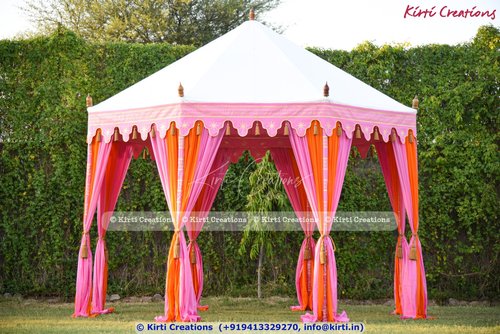
Some structures announce themselves before a single detail registers. A royal Mughal tent is one of them.
Guests arriving at a wedding or a palace lawn know it instantly before they have noticed the arches, the printed linings, or the scalloped edge against the sky; they know they are looking at something regal. That recognition is not an accident. It is the result of design decisions refined over four centuries.
So what exactly creates the effect? Let us take the tent apart, element by element.
A Legacy Written in Fabric
The Mughal emperors did not pitch tents; they raised cities. An imperial encampment was a portable capital, with kitchens, stables, bath tents, and audience halls arranged around the emperor’s pavilion, in a shade of red reserved for rulers alone.
Remarkably, one of these travelling palaces survives complete: the Shahi Lal Dera, the royal red tent associated with Shah Jahan, preserved today in the Mehrangarh collection at Jodhpur, the very city where this craft is still practised. In that tradition, character was never decoration. It was sovereignty made visible in cloth.
The Four Elements That Define a Royal Mughal Tent
Strip away any one of these four, and the spell weakens. Together, they are what separates a traditional Mughal tent from an ordinary marquee wearing a costume.
1. The Silhouette: Arches, Peaks, and Scalloped Valances
Study the tent from thirty feet away before you study anything else. A true royal Mughal tent reads as architecture at that distance, with an arched profile, the layered dual roof, ornamental peaks catching the light, and valances scalloped like the edge of a crown.
If the silhouette alone does not command the lawn, no amount of interior finery will rescue it. Judge the outline first; the Mughals certainly did.
2. The Qanat Walls: A Rampart of Cloth
The qanat, panelled fabric screens that were historically embroidered, appliquéd, or block-printed, is what turns a canopy into an enclosure, and an enclosure into a palace.
Qanat walls give a Mughal tent what open marquees can never offer: rooms, thresholds, privacy, and procession. Ask how the panels are joined and hung, because walls that ripple loosely in the wind break the illusion of permanence that the whole form depends upon.
What you gain: an interior that must be entered, not merely walked beneath.
3. Motifs, Colour, and the Printed Story
Now come closer. Mughal tent design speaks through its surfaces, using floral, geometric, and calligraphic patterns, including the flowering-shrub motif beloved since Jahangir’s day, an emperor famously devoted to botany.
Choose motifs that carry meaning for your family rather than filling space handsomely: a signature flower, heritage colours, patterns echoing the family home. And if the tent will live outdoors through the seasons, insist on dye-fast, hand-block printed motifs on treated canvas, so the story does not fade with the first hard summer.
What you gain: a luxury Mughal tent that is legible, with every panel saying something deliberate.
4. The Interior as Durbar
With a printed ceiling overhead, layered textiles underfoot, and light filtered through fabric rather than glass, the interior of a Mughal pavilion is staged as a durbar, a place of receiving.
Plan the interior around that feeling. Position the seating so arriving guests face the richest panel; let the ceiling, not the furniture, carry the drama.
What you gain: guests who feel received, never merely sheltered.
Character That Endures the Weather
One caution before you commission. All of this character lives or dies on what lies beneath it: a frame engineered to stand firm in wind, treated weather-resistant canvas above the printed linings, and flooring that keeps the durbar dry through a downpour.
Confirm the engineering with the same care you give the motifs. Only a combination of heritage craftsmanship above and modern engineering beneath lets the character last beyond a single season.
Conclusion
The character of a royal Mughal tent is not a mood. It is the sum of deliberate elements: a commanding silhouette, qanat walls, printed meaning, and an interior staged for receiving, each carrying four centuries of reasoning.
Explore our Mughal Tents to see these elements in person, or contact us to commission a tent that carries your family’s colours into the tradition.