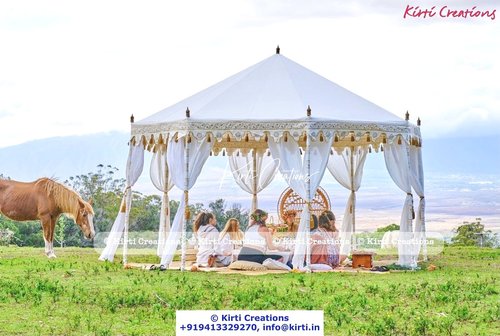
By the time the first guest arrives, the tent has already done its hardest work. The valances hang pressed and even. The hand-printed ceiling glows under the chandeliers. The frame stands perfectly still in the evening breeze, as if it had grown out of the lawn. Nobody photographs this stillness, yet everything photographed that night depends on it.
Months of handwork sit behind a moment like that. And it raises the question every family planning a grand wedding eventually asks: in a country full of tent houses, what actually separates the #1 Swiss tent in India from the rest of the field?
Craft, Not Claims: What First-Rank Actually Means
Here is an honest admission from inside the trade: there is no certificate for being the best tent maker in India. No ranking body, no official list. Any workshop can print the words on a banner.
What cannot be printed is the evidence. First-rank status shows itself in three places: where the maker comes from, how the work is actually done, and how the tent performs on the one day that cannot be repeated. Judge any Swiss tent maker in India against those three tests and the field narrows very quickly.
The rest of this piece applies those tests, so that you can apply them too.
The Legacy Behind Every Swiss Tent
Legacy comes first. Some crafts are passed from one generation to the next, and traditional tent-making is one of them.
Skilled artisans have preserved techniques such as hand block printing, embroidery, stitching, and structural craftsmanship for generations. Their expertise transforms fabric into regal structures that mirror the splendour anticipated with royal weddings and luxury parties.
When you buy a handcrafted Swiss tent, you are investing in craftsmanship that has been honed through years of skill, attention to detail and time-honoured traditions rather than mass manufacturing.
The Craftsmanship Behind Every Royal Wedding
Process is the second test. Four disciplines, each done by hand, decide whether a wedding tent merely stands or truly presides.
Hand-Blocked Linings in the Family’s Colours
Ask any maker you are considering to show you their print blocks, not their brochure. Swiss tents earn their character panel by panel, with artisans pulling each length of lining by hand in motifs and colours chosen for the occasion.
Bring your family colours to the consultation and ask for dye samples on the actual canvas. If the maker offers only standard patterns from stock, you have learned what you needed to know.
Structures Engineered for the Ceremony
A wedding date does not move. Whatever the sky decides, the pheras happen, the baraat arrives, the dinner is served. So the structure beneath the finery must be beyond question.
Ask what wind the frame is braced for and how the canvas is treated against rain. If your dates fall anywhere near the monsoon, insist on sealed seams, layered waterproof canvas and raised flooring as a condition of the order, not an upgrade. The finest embroidery in Rajasthan cannot rescue a flooded aisle.
Guest Suites That Host Like Residences
The great weddings are never one tent. They are small settlements: the ceremony pavilion at the centre, dining tents beside it, and rows of guest accommodation for family arriving from every corner of the country.
This is where the Swiss cottage tent earns its place, offering visiting families a proper suite: a bedroom, an attached washroom with hot water, a veranda for morning tea, interiors ready for cooling or heating as the season demands. Choose a maker who can deliver the whole settlement to one standard, so that the guest experience never dips between the ceremony and the pillow.
Finishing That Photographs Forever
The wedding album is the longest review a tent will ever receive. Decades from now, those photographs will still be passed around the family, and the tent will be in nearly every frame.
So inspect the details that cameras find: the evenness of the scalloped valances, the discipline of every visible seam, the way embroidery meets the light. Compare finishing across two or three makers side by side. At this level, the difference is never in the catalogue photographs. It is in the stitching.
How to Choose Your Swiss Tent Maker
Performance is the final test, and you can examine it before signing anything. Put five requests to any Swiss tent manufacturer in India you are seriously considering.
Visit the workshop in person and watch the printing floor at work. Ask who designs, who prints and who stitches, and whether they are in-house. Request a full trial pitch of your tent before dispatch. Confirm that the maker’s own team handles installation at your venue. And ask for the complete range in one place, from the ceremony pavilion to the last guest suite, so that a single standard of craft runs through the entire wedding.
A maker who welcomes all five requests has nothing to hide. A maker who hesitates has answered a different question.
Conclusion
In this craft, legacy is the only credential that matters. Certificates can be printed, and claims can be made, but the artisans, craftsmanship, and finished tents tell the truth about a maker’s standing. Held to those tests, the #1 Swiss tent in India is simply the maker whose work has been answering them the longest.
Explore our collection to discover handcrafted Swiss tents for royal weddings, or contact us to commission your own and bring your vision to life.